On July 21, 2018 I took my younger son, then 9 and in fourth grade, up Mt Fuji by the Subashiri trail as a day climb, with no hut and no sunrise. It was his first time on Fuji; the summer before, he had climbed Kita-dake on a tent trip. We took 6.5 hours up, spent 1.5 hours on the summit and came down in 2. Each of us ran into trouble high up, at a different point, and that is what I would plan around now. What decides a family day climb on this side of the mountain:1
- Go in a day only if your child already has a long mountain day behind them. The official climbing site calls a hut-less climb very dangerous without enough experience and fitness, and says children run a higher altitude-sickness risk than adults, especially when a first climb costs them sleep.2
- Treat the summit as the turnaround, not the halfway mark. My son climbed faster than the adults around him, then a bad headache came on after lunch at the top; we abandoned the crater circuit a quarter of the way round and he recovered on the way down. The official day-climb plan already runs from 5:00 to 17:00 without the 90-minute circuit, and a weekday shuttle cannot get you started that early.1,2
- Register and pay before you go, children included. Since 2025 the Shizuoka trails require FUJI NAVI registration, an e-learning test and ¥4,000 per person per climb, the same for a child; entering between 2 p.m. and 3 a.m. needs a hut booking.3

Status, checked October 14, 2026
- The Subashiri trail is open from early July to September 10; from 2026 it opens on July 1 rather than July 10 (2026: July 1 to September 10).2
- Private cars are barred from the road to the Subashiri 5th station for the whole season; park at the free Subashiri multipurpose plaza and take the shuttle (2026: July 1 to September 10).2
- Shizuoka's registration and ¥4,000 entry fee apply during the season; the prefecture announces each year's details when decided (the 2026 rules ended on September 10).3
| Route | Subashiri 5th station → summit → crater rim (about a quarter) → Subashiri descent and sand run → Subashiri 5th station (day climb, no hut) |
|---|---|
| Climbed | July 21, 2018, with my younger son (9, fourth grade). Night before in the car at the Subashiri multipurpose plaza; first shuttle up at 5:00 |
| Times | 6 h 30 up, 1 h 30 on the summit, 2 h down (incl. breaks), about 2 hours sooner than planned |
| Weather | Clear, strong sun from the start, sea of cloud below |
| Altitude | Me: headache past the 8th station, then dizziness every few metres. My son: strong on the way up, bad headache after lunch on the summit, eased on the descent |
| Water | About 2 L each planned; ran out early, bought drinks at ¥500 a bottle (2018) |
| Gear | Helmets for both, trekking poles (one pair lent to my son), Buffs and gaiters for the dust; no sunscreen |
One family, one day in 2018. The entry rules, fares and timetables have changed since: check the current ones before you go.
Why we went up and down in a day
In 2018 I chose a day climb for three reasons: I had read that children get altitude sickness more easily if they sleep in a hut, since the risk grows with time spent high; I judged that my son could keep going for one long day; and he goes to bed at 9, so a sunrise climb was never on. I also knew that other books and websites say the opposite, that a hut night is better, and that the answer depends on the child, the parent's skill and how much risk the parent will accept.1
The official site today puts it in a way that cuts both ways. It warns that children, with weaker heart and lung function, are at more risk than adults, particularly when they cannot sleep well on a first Fuji climb, and tells parents never to push them. It also says that climbing without a hut night is very dangerous unless you have the experience and fitness for it. Asked whether children can climb at all, its FAQ says it depends on fitness and experience, notes that climbing tours often take children from fourth grade, and suggests practice hikes on nearby mountains first. My son's practice had been Kita-dake: 9 hours up and 8 down, which he said afterwards was much harder than Fuji, apart from the altitude.1,2
One official step we skipped: the site recommends resting 1 to 2 hours at around 5th-station height before starting. We spent about 10 minutes at the trailhead.1,2
The rules that did not exist in 2018
None of this paperwork applied when we climbed. Shizuoka's Mt Fuji climbing ordinance took effect in May 2025. During the season, everyone entering from the Subashiri, Gotemba or Fujinomiya trailheads now needs three things:3
- Registration in FUJI NAVI, which issues an entry certificate (a QR code) to show at the 5th station; after it is checked you get a wristband.3
- The e-learning on conservation and safety rules, finished with a test on which every answer must be right.3
- The ¥4,000 entry fee per person per climb, paid in FUJI NAVI or at the 5th station in cash or by card; a child pays the same, and a parent can register a child who has no phone as part of the same registration.3
You can do all of it at the 5th station instead, but it takes about 30 minutes and queues form at busy times. On the first shuttle, that is half an hour of a day climb spent in a line. If plans change, the refund is yours to request.3
The second change is the time rule: entering between 2 p.m. and 3 a.m. requires a hut stay, checked at the entrance. It is aimed at overnight "bullet" climbs to the summit for sunrise, which the official site links to altitude sickness and hypothermia. A family starting on an early shuttle is well inside the window; what it removes is the option of a late start. The Shizuoka side sets no cap on numbers.2,3
The climb: a strong child and a struggling parent
We slept in the car at the Subashiri multipurpose plaza; in July 2018 the lot was less than a quarter full. I slept about three hours, got up at 4:00 and joined a queue of about 20 for the 5:00 first shuttle, a 30-minute ride to the trailhead. The day was clear, with a sea of cloud from the start and no shade from the sun. The trail runs through forest that gives shade up to Hon-6th station, then on volcanic gravel, with rock and loose scoria from around the 7th. I lent my son one pair of my trekking poles; they were too long for him, but he used them well.1,2
Water was where my plan failed. Because I kept making my son drink as an altitude measure, our drinks ran out sooner than I expected; on the mountain in 2018 a bottle of water or juice cost ¥500, my cash ran low, and I started on the litre I had carried for summit noodles. The official site does say to drink often, and that sports drinks work better than plain water. Its kit list asks for 1 to 2 litres plus cash and plenty of ¥100 coins, and suggests buying more water at huts rather than carrying it all.1,2
Past the 8th station I got a headache, took ibuprofen, and then had strong dizziness every few metres, like standing up too fast after a bath; I took it for altitude sickness. The official list of altitude-sickness symptoms includes headache and dizziness. The same site's heatstroke signs overlap, light-headedness and heavy sweating, and it notes how little shade the trail has, so on a hot, clear day either can be at work.1,2
My son, meanwhile, was flying, faster than the adults around us and not out of breath, so at safe places I let him go ahead and wait rather than drag him down to my pace. Above Hon-8th the Subashiri trail joins the Yoshida trail and gets very crowded, and from the 9th station up the path is narrow and steep, with a risk of rockfall. We both wore helmets; the official site recommends carrying one.1,2

On the summit: where the day turned
Lunch did not help. I had rationed the noodle water, so the noodles came out too salty and made us thirstier, and we bought juice again. After eating, my son, fine all the way up, said his headache had become bad. We set off round the crater anyway, and about a quarter of the way round he clearly reached his limit; I turned us toward the descent, child first.1
The official site gives the summit air pressure as about two-thirds of sea level and says to go down at once if you feel unwell; losing height is the best remedy and usually brings recovery on its own. The crater circuit takes about 90 minutes. Its day-climb plan warns that adding the circuit brings you down close to 19:00. If a child is still well on top and you want the circuit, the plan is telling you to have the time in hand before you start it. The circuit can open later than the Subashiri trail itself (2026: from July 10), so a family going in the first week of July may not get it at all. With nothing higher than you on the rim, it also says to go down at once at the first thunder, however distant.2
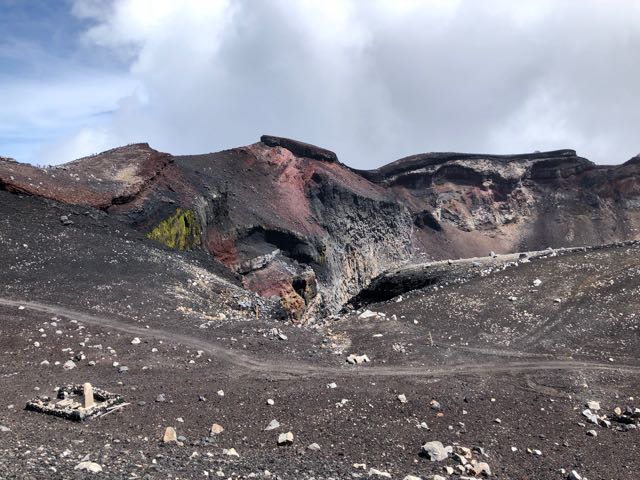
The Subashiri and Yoshida summit has two huts, Yamaguchiya and Ōgiya, for rest, meals and souvenirs, and the official guide warns that the summit can drop below freezing even in summer. The summit toilet on that side asked a ¥300 tip in 2026.2

Down: the sand run and the Yoshida fork
The descent is a separate trail. At the 8th-station hut Shimo-Edoya it splits from the Yoshida descent; the official site tells you to check the red Subashiri signs there. Below the 7th station the sunabashiri begins, a sand-and-gravel run that drops about 700 m.2
As we lost height, my son's symptoms eased bit by bit; once I showed him how to run the sand, he picked it up quickly and we came down very fast. The dust was thick and we wore Buffs over nose and mouth. His gaiters were not breathable, and he finished with heat rash round both ankles. There are rocks hidden in the gravel, and the official site notes that most accidents are falls on the way down, on steep rock or the sand run. In an emergency, call 110 above the 6th station and 119 near the 5th station.1,2
Times on the day
| Section | Mine, July 2018 (with breaks) | Official |
|---|---|---|
| 5th station → summit | 6 h 301 | 6 h 25 without breaks; Shizuoka's pamphlet says about 7 h2 |
| On the summit | 1 h 30; crater circuit stopped a quarter of the way1 | Crater circuit about 90 min2 |
| Summit → 5th station by the sand run | 2 h1 | 3 h 20; Shizuoka's pamphlet says about 4 h2 |
| Whole day | about 10 h on the mountain1 | Day plan: 5:00 to 17:00, including rests and lunch2 |
Before the trip I had told myself to allow about 1.5 times the adult standard for a child; we finished about two hours earlier than I expected. That is one climb with a fast child, and on the way up I was the slow one.1
Getting to the Subashiri 5th station
By car. Park at the free Subashiri multipurpose plaza and take the shuttle; in 2026 the first ran at 4:30 on weekends and holidays and 5:30 on weekdays, and the last came down at 19:00 on weekdays and 20:00 on weekends. Return fares in 2026 were ¥2,400 for adults and ¥1,200 for children; we paid ¥1,600 return in 2018, children half. No public bus or shuttle reaches the 5th station before 4:30. On a weekday the 5:30 shuttle means starting about an hour and a half later than the official plan, which leaves roughly half an hour before the last shuttle down and no time for the crater circuit.1,2
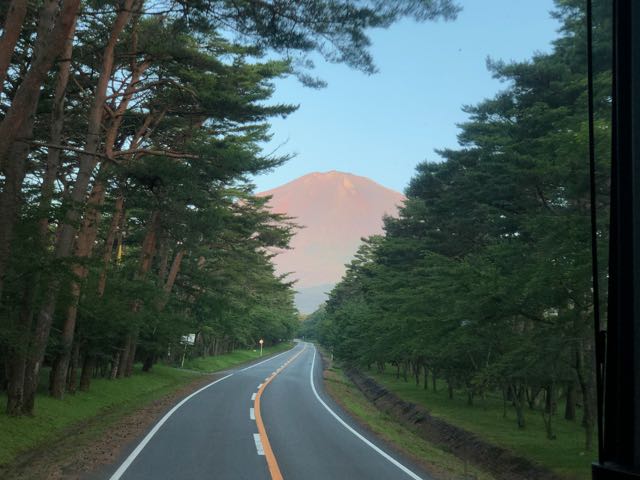
By train. Buses run from Gotemba Station to the Subashiri 5th station in season (daily from July 1 in 2026); the first reached the 5th station at 7:45 and the last bus down left at 19:00, or 20:00 on weekends and holidays only (2026). Fares were ¥1,780 one way for adults and ¥890 for children. The official day plan allows 30 minutes at the 5th station before a 5:00 start and 12 hours on the trail; from a 7:45 bus arrival that puts you back after 20:00, past the last bus even on a weekend. So by bus alone a day climb does not fit. Either reach the Subashiri plaza for the first shuttle (4:30 on weekends and holidays, 5:30 on weekdays) by car or taxi, or book a hut night; huts on the trail take advance bookings only, and there are huts from the 5th station up.2
When to go. The trail is busiest from late July to late August, above all at weekends. In 2025 the Ministry of the Environment counted 21,792 climbers on Subashiri against 121,068 on Yoshida. Huts and toilets can close before the season ends, especially from late August.2,4
What I would pack differently
Sunscreen: I skipped it and paid with a badly burned face. Breathable gaiters for the child, and a mask or Buff for the dust. More cash for drinks and toilets, which ask tips of about ¥100 to ¥300. Less summit cooking gear: the stove, pot, table and extra litre of water added several kilos to my pack. Boots, separate rain jacket and trousers, and warm clothing are mandatory, and gear may be checked at entry.1,2
