- Japan's summer lightning runs on a schedule
- Why the storms come in the afternoon
- Reading the warning: the 30-30 rule
- Where to shelter, in order
- The last-resort posture on a ridge
- A myth worth dropping: metal does not attract lightning
- The bottom line
Japan's summer lightning runs on a schedule
If you hike Japan's high mountains in summer — the Northern and Southern Alps, the volcanoes, any exposed ridge — afternoon thunderstorms are not bad luck. They are a near-daily pattern, and they kill exposed hikers most years. The good news is that this pattern is predictable, which means it is largely avoidable. The single most effective thing you can do about lightning in Japan is decided the night before, not on the ridge: start early, and be off the high ground by early afternoon.
This guide gives you the rest — how to read the warning signs, where to shelter and where never to, and the last-resort posture if a storm catches you exposed — using the criteria the Japan Meteorological Agency (JMA) and the Japan Alpine Club publish. None of it replaces the plan, but it lowers the gamble.
Why the storms come in the afternoon
Most summer mountain lightning falls from cumulonimbus clouds that build through the afternoon. The mechanism is the day's heat: as the ground warms and cold air sits aloft, the temperature gap drives strong updrafts. Moist air is lifted hard, and the fair-weather cumulus that sprouted in the morning towers up into a thunderhead by early afternoon. That is Japan's "afternoon lightning" (yuudachi storms).
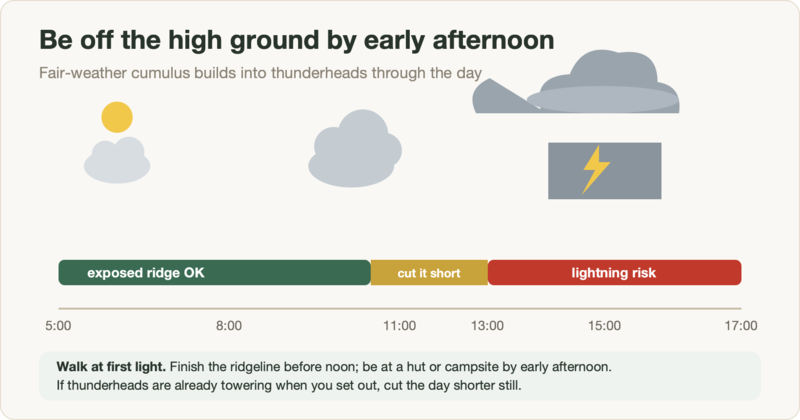
Turn that around and the defense is obvious: cross the exposed sections in the morning. Walk at first light, finish the ridgeline before noon, and be at a hut or campsite by early afternoon. If the clouds are already towering when you set out, cut the day even shorter. The plan that keeps you off dangerous ground at a dangerous time beats any technique for surviving once you're caught.
One tool before you leave: the JMA Lightning Nowcast (kaminari nowcast) analyses the whole country on a 1 km grid, updates every 10 minutes, and shows lightning activity up to an hour ahead — usable on your phone while you still have signal. Checking the previous evening's pressure chart for cold air moving in aloft tells you, in advance, whether it's a storm-prone day.
Reading the warning: the 30-30 rule
Whether lightning has reached striking range is something you can judge by the gap between flash and thunder. Light arrives instantly; sound travels about 340 m per second. Count the gap and you have the distance.
The first "30" — flash to thunder within 30 seconds. If thunder follows the flash in 30 seconds or less, the storm is within ~10 km — and a strike can land anywhere in that radius. Under 30 seconds, treat yourself as inside the danger zone: stop climbing and move to shelter. If the gap closes to 5 seconds (~1.7 km), it is critical — the next bolt could be on you.
The second "30" — wait 30 minutes after the last thunder. A storm that seems to have passed can redevelop or be followed by another cell. Stay put in a safe spot for 30 minutes after the last thunderclap, even if the rain eases and blue sky appears. That pair is the "30-30 rule."
Signs the cell is right on you — act on these before you even hear thunder:
- Big raindrops, or hail or graupel, starting to fall — even a few.
- A sudden cold gust blowing down on you.
- A flat-topped anvil cloud towering overhead or upwind.
Where to shelter, in order
Only a few places truly protect you. The JMA rates as "relatively safe": reinforced-concrete buildings, and the inside of a car, bus, or train (not open-topped). In the mountains, a reinforced mountain hut is your first choice — get inside. Even a wooden hut is far safer than the open if you stay inside and keep 1 m or more from walls, the ceiling, and electrical fittings.
The hard case is when safe shelter is far or absent. The JMA and Japan Alpine Club define a minimal "protection zone": if there is an object 4 m or taller (a tower, a utility pole), get inside the area where you can look up at its top at an angle of 45 degrees or more — but stay at least 2 m away from the object itself. Too close, and a bolt hitting it can jump across to you (a side-flash).
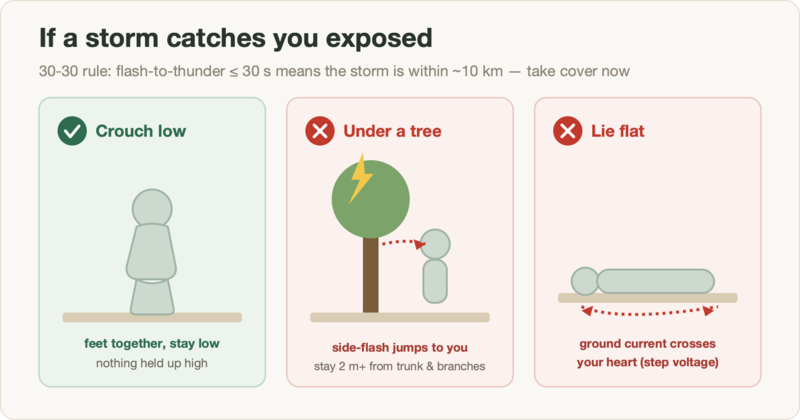
The thing you must never do is shelter under a tall tree or a hut's eaves. Lightning that hits a tall tree or pole jumps from it to a nearby body — a side-flash — and after direct strikes, this is the most common way people are killed. Trying to keep dry under a big tree is exactly the dangerous move. Stay 2 m or more from any trunk, branch, or leaf.
The last-resort posture on a ridge
A ridge or summit is, by its shape, the high point. If a storm catches you on an escape-less ridge, lose as much height as you safely can — move to creeping-pine, a hollow, anywhere lower — and then:
- Crouch low with your feet together, so only your boot soles touch the ground. Don't hold anything (poles, etc.) up above your head.
- Do not lie down or go flat. When lightning strikes nearby, ground current flows between your two feet (step voltage). Crouched with feet together, little of it crosses your heart; lying down puts a large part of your body on the ground and raises the chance current passes through your chest.
- Get low inside a hollow if there is one — any ground lower than its surroundings improves the odds.
- Spread the party out — 15 m or more apart. If a strike does land, separation means it can't incapacitate everyone at once, and the unhurt can reach the injured and call for help. Crouch individually, not huddled.
This posture is not "safe" — it only shaves the odds. Which is exactly why the priority is to act at the warning stage, before you are ever forced into it.
A myth worth dropping: metal does not attract lightning
A common piece of mountain advice is "take off your poles, ice axe, necklace — anything metal." But the JMA and the Japan Alpine Club both state that wearing metal does not change your chance of being struck. Lightning hits the tallest thing in the area; it is decided by height, not by metal. The Japan Alpine Club's guidance explicitly says you may keep metal items on while you evacuate.
What actually matters is not sticking a long object up above your body — standing a pole upright, opening an umbrella, raising anything with a pointed tip invites the strike. Fumbling to remove metal while your evacuation stalls is worse than useless: lay the long things down and move, low, to a safer place.
The bottom line
The most effective lightning skill in Japan's mountains is not the ridge crouch. It is to clear the exposed ground in the morning, break off your day at the first warning signs, and reach safe shelter before you ever hear thunder. Once a storm has you cornered, all you can do is shave the odds. There is no zero-risk against weather you can't perfectly predict, and the final call to move or stay is yours and your party's — so carry as much decision-making material as you can.
Same season, same mountains, other hazards worth reading before you go: swollen stream crossings, heat and humidity, and the wet-forest leeches and ticks.
